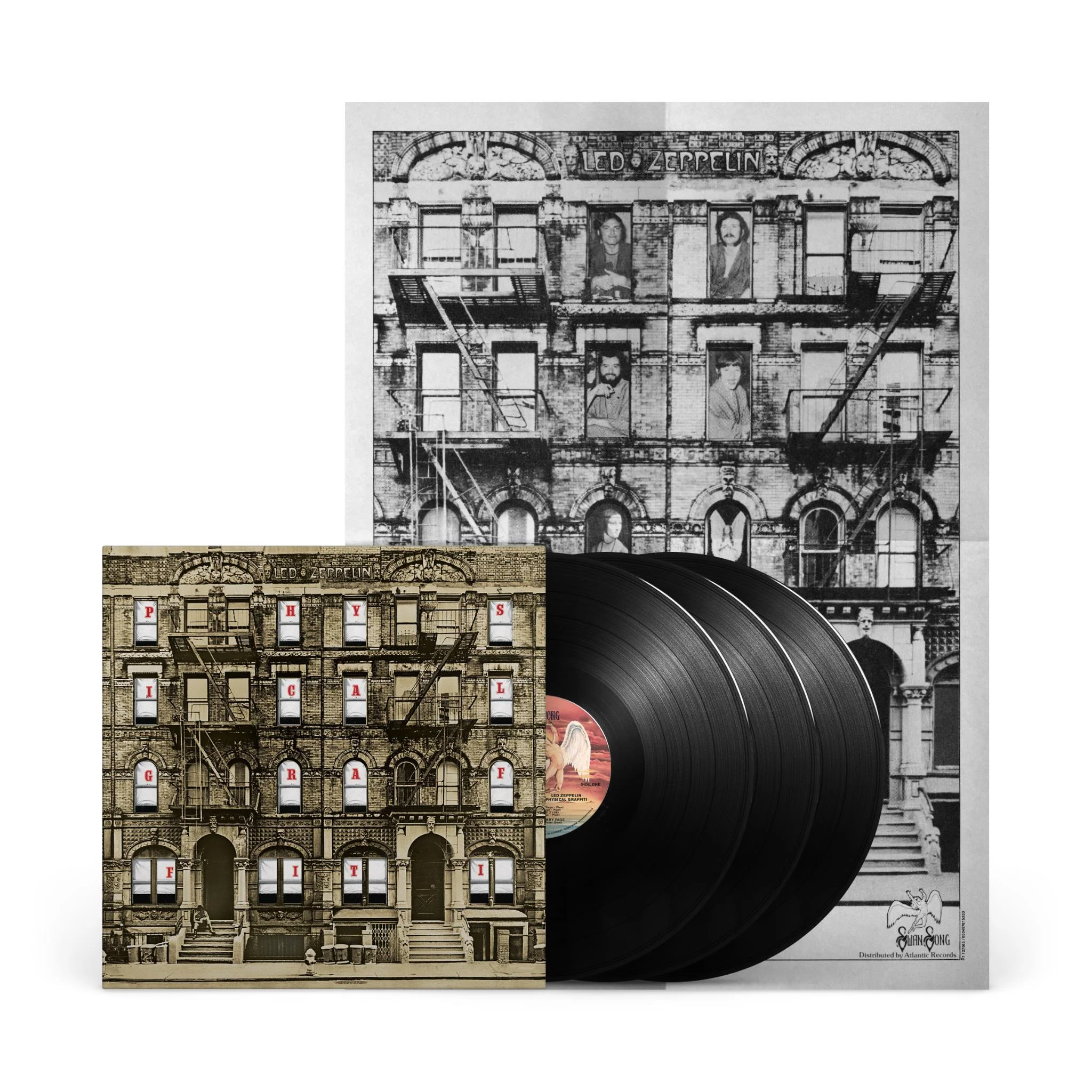
Physical Graffiti (50th Anniversary Edition Vinyl)
Released on February 24, 1975 in the US (and four days later in the UK), Physical Graffiti immediately achieved platinum sales status and has recently been certified 17x platinum. Its commercial success was equalled by its critical reception.
Generally regarded as one of the greatest double albums of all time, the original 15 tracks represent a creative tour de force that explores the band’s dynamic musical range, from the driving rock of “Custard Pie” to the exotic construction of “Kashmir” and the funky groove of “Trampled Under Foot.”
“It goes from one extreme to the other but at the same time, it’s very evident that it’s Zeppelin… I love the album and it does work as a double album. There are some real humdinger, roaring tracks.” Robert Plant
Physical Graffiti was comprised of new compositions including “Kashmir”, “Sick Again”, “Ten Years Gone”, “The Wanton Song”, “Custard Pie”, “Trampled Under Foot” and “In My Time Of Dying”, as well as unreleased songs from earlier album sessions: “Houses Of The Holy”, “The Rover”, “Black Country Woman” (from Houses Of The Holy sessions), “Down By The Seaside”, “Boogie With Stu”, “Night Flight” (from Untitled, a.k.a. Led Zeppelin IV, sessions), and “Bron-Yr-Aur” (from Led Zeppelin III sessions).
Jimmy Page began the initial work at his home studio in Plumpton, Sussex, England, in the summer and autumn of 1973, with the first recording sessions taking place that October at Headley Grange, using Ronnie Lane’s Mobile Studio. Further sessions at Headley continued in January 1974. Additional overdubs were recorded at Olympic Studios, where Page completed mixing of the album in July 1974.
“We had enough material for one-and-a-half LPs, so I figured, ‘Let’s put out a double and use some of the material we’d done previously but never released’. I always thought the sequencing of an album was really important and that was part of my role as the producer." Jimmy Page
Physical Graffiti was not only the band’s first double LP, it was also the first release on their new label, Swan Song, which launched in May 1974. The album’s release was announced on November 13, 1974.
“I’m a big fan of Physical Graffiti. [It] was very wide ranging. It probably was a pinnacle.” John Paul Jones
Following the 10-week North American tour that ran from January through March, 1975, Led Zeppelin played five sold-out nights at London’s Earl’s Court in May, 1975. Initially, three shows were announced, with another two added after the tremendous demand for tickets.
“On the last night at Earl’s Court we played ‘Heartbreaker’, ‘Black Dog’, and a bit from ‘Out On The Tiles’. With the songs from Physical Graffiti we’ve got such a wide range of material.” John Bonham
Released on February 24, 1975 in the US (and four days later in the UK), Physical Graffiti immediately achieved platinum sales status and has recently been certified 17x platinum. Its commercial success was equalled by its critical reception.
Generally regarded as one of the greatest double albums of all time, the original 15 tracks represent a creative tour de force that explores the band’s dynamic musical range, from the driving rock of “Custard Pie” to the exotic construction of “Kashmir” and the funky groove of “Trampled Under Foot.”
“It goes from one extreme to the other but at the same time, it’s very evident that it’s Zeppelin… I love the album and it does work as a double album. There are some real humdinger, roaring tracks.” Robert Plant
Physical Graffiti was comprised of new compositions including “Kashmir”, “Sick Again”, “Ten Years Gone”, “The Wanton Song”, “Custard Pie”, “Trampled Under Foot” and “In My Time Of Dying”, as well as unreleased songs from earlier album sessions: “Houses Of The Holy”, “The Rover”, “Black Country Woman” (from Houses Of The Holy sessions), “Down By The Seaside”, “Boogie With Stu”, “Night Flight” (from Untitled, a.k.a. Led Zeppelin IV, sessions), and “Bron-Yr-Aur” (from Led Zeppelin III sessions).
Jimmy Page began the initial work at his home studio in Plumpton, Sussex, England, in the summer and autumn of 1973, with the first recording sessions taking place that October at Headley Grange, using Ronnie Lane’s Mobile Studio. Further sessions at Headley continued in January 1974. Additional overdubs were recorded at Olympic Studios, where Page completed mixing of the album in July 1974.
“We had enough material for one-and-a-half LPs, so I figured, ‘Let’s put out a double and use some of the material we’d done previously but never released’. I always thought the sequencing of an album was really important and that was part of my role as the producer." Jimmy Page
Physical Graffiti was not only the band’s first double LP, it was also the first release on their new label, Swan Song, which launched in May 1974. The album’s release was announced on November 13, 1974.
“I’m a big fan of Physical Graffiti. [It] was very wide ranging. It probably was a pinnacle.” John Paul Jones
Following the 10-week North American tour that ran from January through March, 1975, Led Zeppelin played five sold-out nights at London’s Earl’s Court in May, 1975. Initially, three shows were announced, with another two added after the tremendous demand for tickets.
“On the last night at Earl’s Court we played ‘Heartbreaker’, ‘Black Dog’, and a bit from ‘Out On The Tiles’. With the songs from Physical Graffiti we’ve got such a wide range of material.” John Bonham
Description
Released on February 24, 1975 in the US (and four days later in the UK), Physical Graffiti immediately achieved platinum sales status and has recently been certified 17x platinum. Its commercial success was equalled by its critical reception.
Generally regarded as one of the greatest double albums of all time, the original 15 tracks represent a creative tour de force that explores the band’s dynamic musical range, from the driving rock of “Custard Pie” to the exotic construction of “Kashmir” and the funky groove of “Trampled Under Foot.”
“It goes from one extreme to the other but at the same time, it’s very evident that it’s Zeppelin… I love the album and it does work as a double album. There are some real humdinger, roaring tracks.” Robert Plant
Physical Graffiti was comprised of new compositions including “Kashmir”, “Sick Again”, “Ten Years Gone”, “The Wanton Song”, “Custard Pie”, “Trampled Under Foot” and “In My Time Of Dying”, as well as unreleased songs from earlier album sessions: “Houses Of The Holy”, “The Rover”, “Black Country Woman” (from Houses Of The Holy sessions), “Down By The Seaside”, “Boogie With Stu”, “Night Flight” (from Untitled, a.k.a. Led Zeppelin IV, sessions), and “Bron-Yr-Aur” (from Led Zeppelin III sessions).
Jimmy Page began the initial work at his home studio in Plumpton, Sussex, England, in the summer and autumn of 1973, with the first recording sessions taking place that October at Headley Grange, using Ronnie Lane’s Mobile Studio. Further sessions at Headley continued in January 1974. Additional overdubs were recorded at Olympic Studios, where Page completed mixing of the album in July 1974.
“We had enough material for one-and-a-half LPs, so I figured, ‘Let’s put out a double and use some of the material we’d done previously but never released’. I always thought the sequencing of an album was really important and that was part of my role as the producer." Jimmy Page
Physical Graffiti was not only the band’s first double LP, it was also the first release on their new label, Swan Song, which launched in May 1974. The album’s release was announced on November 13, 1974.
“I’m a big fan of Physical Graffiti. [It] was very wide ranging. It probably was a pinnacle.” John Paul Jones
Following the 10-week North American tour that ran from January through March, 1975, Led Zeppelin played five sold-out nights at London’s Earl’s Court in May, 1975. Initially, three shows were announced, with another two added after the tremendous demand for tickets.
“On the last night at Earl’s Court we played ‘Heartbreaker’, ‘Black Dog’, and a bit from ‘Out On The Tiles’. With the songs from Physical Graffiti we’ve got such a wide range of material.” John Bonham